
The Crane
It dipped its beak into the water, its eye a dead black disc.
We didn’t know it when we lived there, but years later, men in coveralls and yellow hard hats would clear our grove of dead avocado trees and demolish our house. They began by tearing out the walls and floors, collapsing sheetrock and stucco, and carting away broken fixtures and hastily shredded carpet. Some workers dismantled the frame, salvaging the beams and posts, before a bulldozer leveled the foundation and dump trucks carted away the concrete and wood debris. They approached each eucalyptus one by one, sawing off the limbs, felling the tall trunks, and, finally, uprooting the stumps with an excavator.
They dredged the creek with a backhoe, ripping free waterlogged cottonwood branches, stones, and dead roots. The insects, salamanders, frogs, and occasional fish escaped to the valley’s marshes. The crew dug a deep pit in the field, lined it with gravel, and diverted the creek into it, creating a reservoir.
Four years later, our house and 30 acres of surrounding land were part of an 18-hole golf course adjacent to single-family tract housing priced for upper-middle-class families. The duplexes, all stucco with red, cylindrical shingles, clustered around the reservoir. Landscapers planted non-native green reeds at the edge of the reservoir. From any point after the 9th hole, golfers could enjoy an unobstructed view of the ocean below the Mesa.
The house had the same chipped white paint as the barn beside it. It was a place for people who did not matter. No one considered it a town, just an overpass above the freeway, endless dry fields to the east, and rolling hills overgrown with trees and brush on our side to the west. Though we could not see it, we weren’t more than a few miles from the Pacific Ocean. A chaos of eucalyptus and manzanita surrounded the property. Each tower was surrounded by pods, bark, and thick piles of scythes, shielding us from the sun and suffocating us in menthol dust. We called it the Mesa. It was unincorporated and secluded: sandy hills covered with eucalyptus trees and ice plant, with dilapidated houses, barns, mobile homes, and trailers, each with a shallow well and septic tank, unlike the valley or the beach, with their hotels, townhomes, and bungalows.
An abandoned fruit stand marked our driveway. Behind the fruit stand, an aluminum gate, an orchard of avocado trees, a barn, and finally, our home. We had a dirt driveway. Trees surrounded the property: eucalyptus to the north and south, sycamore trees along the hillside to the west, and avocado trees to the east. The orchard was once a dependable business, and the former owner sold avocados, nuts, and fruit from a roadside stand. Since then, the grove went barren; an outbreak of sun blight killed all the trees. Dad bought the house, barn, orchard, and fruit stand for a pittance. Instead of replanting trees or tearing down the stand’s frame, he kept everything as it was: trees no longer bearing fruit. They grasped upward, desperately through the dry dirt and mat of curved leaves.
A creek ran in front of that house under a simple bridge, 2x4 boards across I-beams connecting two concrete slabs. Sycamore and dogwood grew along the banks, followed by tall, dry grass. Patches of burdock rose so dark they appeared burnt, vestiges of a fire that never happened. Green watercress shoots settled along the edges of the creek. A breeze gathered in the dogwood, wound through the tiny white flowers, then over the brush and the grass.
Halmoni squatted with her hips at her heels, one hand folded behind her back, the other holding a lit cigarette to her mouth. She barely exhaled–ash fell into an empty RC Cola can.
Ya iruwa, saekki-ya!
She waved her hand toward her side.
Neh, halmoni?
She pointed to the edge of the creek with her cigarette, wide-eyed. She grinned with her mouth open, her teeth gray and yellow.
Juh durumi jom bwa!
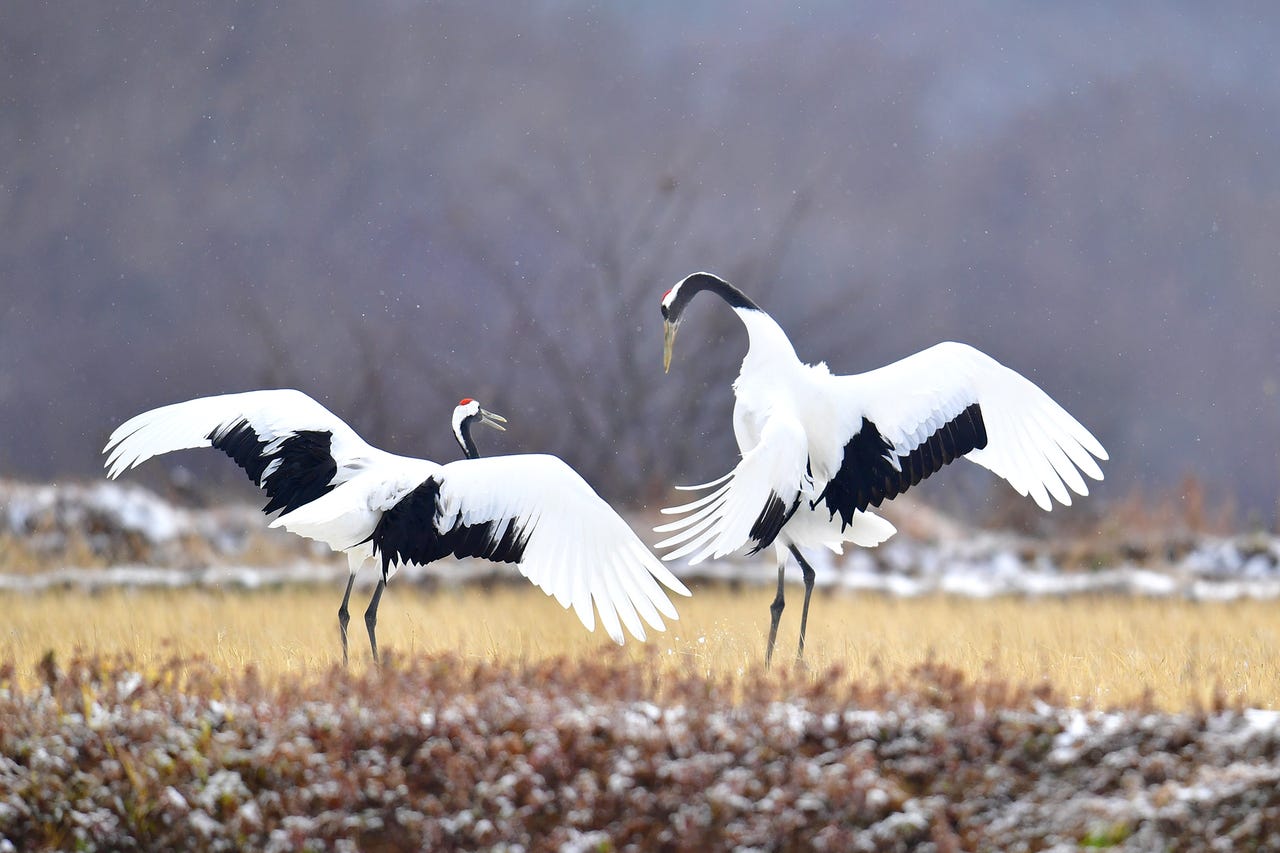
The crane’s legs bent so that its knees faced behind it. It was taller than I was. Purposeful but tentative, a step, another, three black toes digging under the surface of the mud, then the others following. It dipped its beak into the water, its eye a dead black disc.
Yaaaaa!
A loud crack. Dad started his white Chevy van, with its rusted-through back panels and asthmatic engine. It backfired, spilling smoke from the exhaust. The crane’s wings rose instantly, and the yellow and black beak pointed into the air. Its wings heaved downward once, then fluttered, and the crane slowly lifted into the air. We saw it make its way up into the sky, then glide out of view, disappearing from our world.
Just damn
I love this beyond words. Your description of the Mesa hit me in the chest with recognition. <3 Beautiful.