
Zugunruhe
An entire colony of birds can sense a disturbance en masse, all rising together in response to the distress of a single member: a low-flying hawk, or the slam of a car door
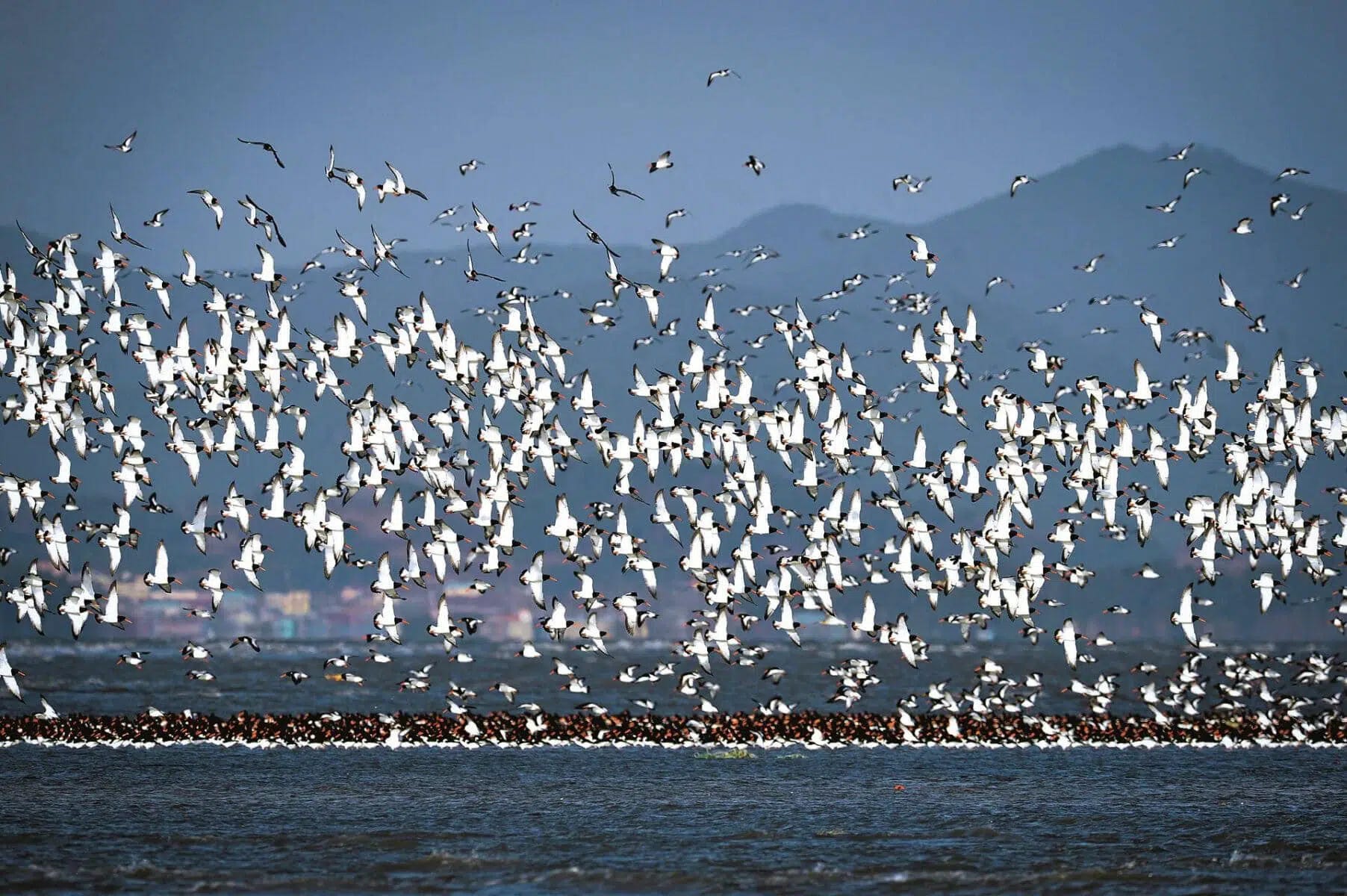
Birds migrate in the winter. They follow the sun, from Eastern Russia and Alaska down through Korea to Australia and New Zealand. Korea is a stop on the Asian-Australasian Flyway.
During the Korean War, wetlands rich in mollusks and worms extended from Korea into China. In Pusan, at low tide, miles of mudflats were full of mollusks, clams, and conches. On those mudflats, Halmoni walked with Mom—only eight years old—who held her younger brother’s hand. Mom was the one whose body would remember.
An entire colony of birds can sense a disturbance en masse, all rising together in response to one member’s distress. They float up in the air in what zoologists call a “panic” or sometimes a “dread.” The sparrows in the yard rose when Dad’s van backfired. In Korea, an automobile was an unattainable luxury.
Our brains are closer to birds’ brains than we realize. Both have a hypothalamus, which performs similar functions: hormones from the pituitary gland regulate temperature, hunger, thirst, fatigue, sleep, and circadian rhythms, as well as attachment and maternal instinct.
There is a German word for the restlessness that birds feel when they want to fly: Zugunruhe. Scientists can cause it in caged birds by using lamps to mimic seasonal changes. Even with nowhere to go, the birds try to migrate. They flutter at one corner of the cage, all while facing south, a place they cannot reach.
A blackcap raised in a basement in Munich never sees the sky. Still, it grows restless at the right week in autumn and leans southwest. Its hormones rise. It eats more and lays down fat for a journey it does not know. In an Emlen funnel, a paper cone recording the bird’s hops in ink, the captive leaves marks showing where it wants to go. The ink points south. The bird does not know the cage is the world.
Mom’s walk across the mudflats was not a bird migration; it was a push, like a flock rising when a hawk passes. There was no pull of a moving sun, no territory waiting in the south, no warm food laid down by an ancestor—only leaving, and then staying. Something gets passed from a body that has walked this path. When Mom was eight, she held her younger brother’s hand. By the time she had a son to run to, the walk was already decades old, yet her body kept running it. She did the dishes before bed, checked the doors twice, and when a car backfired, Mom went still in the kitchen, pausing longer than the sound lasted.
Some researchers say cortisol regulation runs in the blood. A body holds what came before. I remember the house I grew up in. I can see Halmoni washing dried soybeans, soaking them overnight, and boiling them in a worn iron gamasot. Steam rose from the sokuri, bamboo frayed at the edges. The heavy wooden jeolgu pounded cooked beans. Her hands formed the paste into cakes. She fermented soy along the walls of her storehouse in Pyongyang, tying bricks with straw. The smell was pungent and savory throughout a house I had never seen. It never existed during my lifetime. A son can still point toward a homeland he never saw. He points anyway. Ink records a bird’s feet on paper.
Halmoni carried han. The Korean word for what is carried in the chest until it must be admitted is hwa-byung: fire illness. It appears in the DSM-5’s appendix as a Korean-Cambodian syndrome, while han—the deeper grief—remains unlisted.
Hwa-byung, fire illness, shows up as a heat in Halmoni’s chest, rising in the middle of the night. She shakes, strikes herself with a fist, and clutches her pillow. Palpitations. Insomnia. A woman who endured what could not be spoken, who lost children. Han is the sorrow of a peninsula colonized and then severed, the kind of sorrow that needed a name. A peninsula severed in 1953: families cut in half and a border that has deepened. The migration that was supposed to happen, north to south, south to north, toward Halmoni’s brick house, has run inside the chest of three generations. Zugunruhe points at a horizon. Hwa-byung is what stays in the chest when there is nowhere left to point.
The hypothalamus passes the fire down. It goes from mother to daughter, to son. A fire sparked by history.